



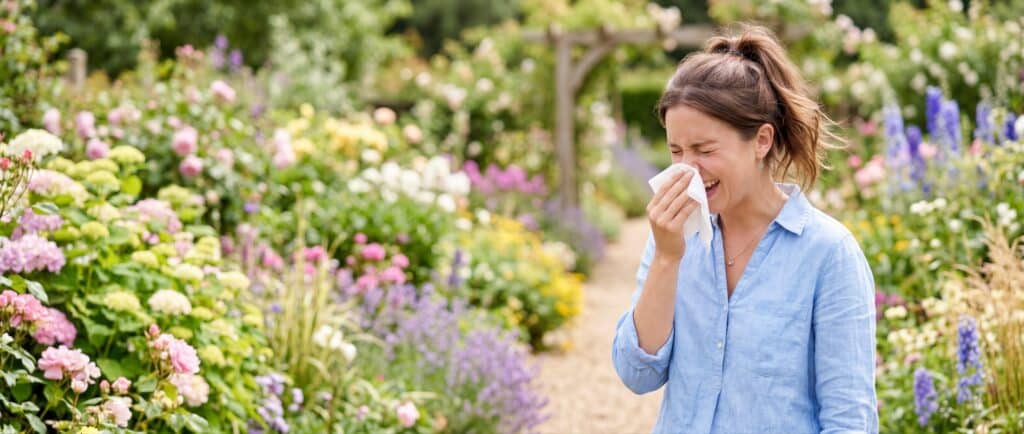
A few sunny days and all of a sudden the trees burst into blossom and the fields throughout the UK turn bright yellow with the oils seed rape bursting into flower. As lovely as it is to see sunshine and spring flowers, for many it heralds a time of misery with hayfever other allergies appearing.
Around 26% of adults suffer from hayfever according to Allergy UK. Levels have tripled over the past 20 years.
Allergy UK state that cases have tripled in the last 20 years affective 10-15% of children and 26% of all adults. That is around a quarter of the population who suffer anything from mild sneezing to streaming eyes, bunged up noses, skin irritations, and more.
For many people, the hard part is working out which pollens cause them the most problems. For some it will be grass pollens and they often don’t get a reaction until June time, for others it is the tree pollens and that can start from March. If you are able to work out when you are at your worst, sometimes you can help prepare a bit earlier and reduce symptoms.
It is also worth bearing in mind that for someone with hayfever, it isn’t just the sneezing, it can be tiredness and stress from constantly experiencing the issue. And those might need to be addressed too.
There are lots of traditional solutions from using local honey early in the season to help build up a tolerance to local pollens, to keeping windows closed all day to help stop pollens landing on bedding and clothing. Wearing sun glasses even on dull days and using barrier creams just inside the nostrils to ‘catch’ the pollen and stop it travelling up the nose.
Simple solutions like slices of cucumber can soothe irritated eyes for fast and gentle relief.
It can take time to find out what works and sometimes very simple solutions such as soothing the eyes with slices of cucumber can provide some instant relief even if you need to repeat it multiple times through the day. It is also worth considering what supplements you could be taking to support through the pollen season.

Firstly as always, a varied and balanced diet with plenty of variety is key in helping provide essential nutrients and fuel for the body. As is good hydration, so keep fluid levels topped up too.
Nettle tea is often used at this time of year and is worth a try. It may be an acquired taste and is better if you let it cool to warm rather than drinking it very hot.
Taking a multivitamin can give you a wide spectrum of nutrients to help support the body when allergies place extra demands on you.
When it comes to supplements, this is where a multivitamin and mineral is useful. Providing a range of all the major nutrients it will include vitamin A or Beta carotene which helps maintain the health of the mucous membranes, as well as support for the immune system with vitamins C, D and the mineral zinc.
Although we can manufacture vitamin D from sunlight, if the weather is not good or you keep your skin covered most of the time, you may find it harder to make the vitamin and a supplement can be helpful. Vitamin D is important for the immune system and that will be working overtime if you suffer from allergies.
Quercetin is a bioflavonoid found in many citrus fruits, the downside is that it is found in the white pith of fruits such as oranges, so we often don’t eat it. Quercetin has been shown to be helpful in helping dampen down an allergic response. It may be in your multivitamin, but if not you can find it as a stand alone supplement or it is found with vitamin C. Check your labels!


Bromelain is found naturally in papaya and pineapple and has an anti-inflammatory effect. Try to add these fruits to your diet or consider a supplement as some users find this useful.
Not a week goes by without talk of the gut microbiome in the news. Science is now showing us that the good bacteria in the gut has an effect on many aspects of health. Not just good digestion, ensuring you get the best out of your food, but also supporting the immune system and even mood.
Experiencing an allergic response on a daily basis can be tiring and stressful, so looking after mood and stress levels is also key. Apart from the friendly bacteria supplements, you could also consider B vitamins and magnesium, which contribute to normal psychological function and help to reduce tiredness and fatigue.
It can be tricky discovering what makes your particular allergy worse, but keeping a note of how you are on each day, weather conditions and what you ate, can help give you a picture over a period of a couple of weeks and just might give you some pointers as to what works best for you or what your triggers are.
It is also important to make sure that your symptoms are allergies and not something else, so if you feel unsure or things are not improving even when you take steps to make changes, it is worth checking things out with your GP.
Simple changes can make a significant improvement, so before the pollens hit us at full force, take a look at where you could give yourself some extra support and be able to make the most of the (hopefully) forthcoming good weather.


